Self-hosted infrastructure · single node

Your own cloud.
Running on a laptop.

Fourteen containers, an encrypted data volume and a git-defined configuration. Photos, media, files, secrets and telemetry — all private, all reproducible, deployed by a timer that validates before it touches anything.

View architecture → Read the source

Built by Ajinkya Yadav GitHub ↗ LinkedIn ↗

uptime 10d · 14/14 containers healthy · last deploy: automated

14containers
3public endpoints
5 mindeploy loop
0 Blost on rebuild
homelab · dashboard

Homelab control dashboard: CPU, memory, temperature, storage and per-service widgets

Platform

One box that behaves like a small datacenter

Each layer has one job, one config file and one way to be deployed.

Media & photos

Jellyfin for films and music, Immich (server + ML + Postgres + Redis) for a 50 GiB photo library, File Browser over the encrypted disk.

6 containers · tailnet + funnel

Observability

Netdata metrics, Dozzle logs, Scrutiny SMART health and a status endpoint — the dashboard reads all four live.

4 containers · internal

Secrets & identity

Vaultwarden behind an authenticated endpoint; every service gets its own credentials, nothing is reused or stored in git.

1 container · funnel

Automation

n8n workflows, nightly snapshots and a morning digest. Failures dedupe into a single alert instead of a mailstorm.

cron + n8n · internal

Storage

LUKS-encrypted volume for live data, a separate backup disk, and SMART thresholds that fire before a drive dies.

3 drives · ext4

Network

No router port-forwards. WireGuard mesh for devices, three explicit Funnel endpoints for the internet, private bridges for databases.

tailscale · wireguard

Pipeline

Config is the deployment

Every change takes the same four steps. Nothing is edited by hand on a running container.

01

Edit config

Compose file or stack config lives in git, next to the code that runs it.

02

Validate

CI resolves every compose file, lints deploy scripts and scans for secrets.

03

Deploy

A 5-minute timer pulls, re-checks and recreates only the stacks whose hash changed.

04

Observe

Metrics, logs and SMART health land on the dashboard; failures emit one event.

Specs

What is actually running

Hardware is unremarkable on purpose — the point is that the platform survives losing it.

Host
Ubuntu 22.04 · AMD laptop silicon · 5.7 GiB RAM + 2 GiB swap · always-on
Runtime
Docker Engine + Compose · one compose project per stack · read-only socket for dashboards
Network
Tailscale mesh · Funnel for 3 public endpoints · no inbound ports on the router
Storage
LUKS-encrypted 458 GB data volume · 916 GB backup disk · SMART watched
Delivery
Git-validated deploys every 5 minutes · automated rollback on invalid config
Recovery
Host rebuilt from repo after a boot-drive failure — zero data loss

Stack

Composed of boring, proven parts

Docker ComposeUbuntuTailscale JellyfinImmichPostgres Redis / ValkeyVaultwardenn8n NetdataDozzleScrutiny HomepageGitHub Actionsgitleaks LUKSsystemd

Topology

Everything in one picture

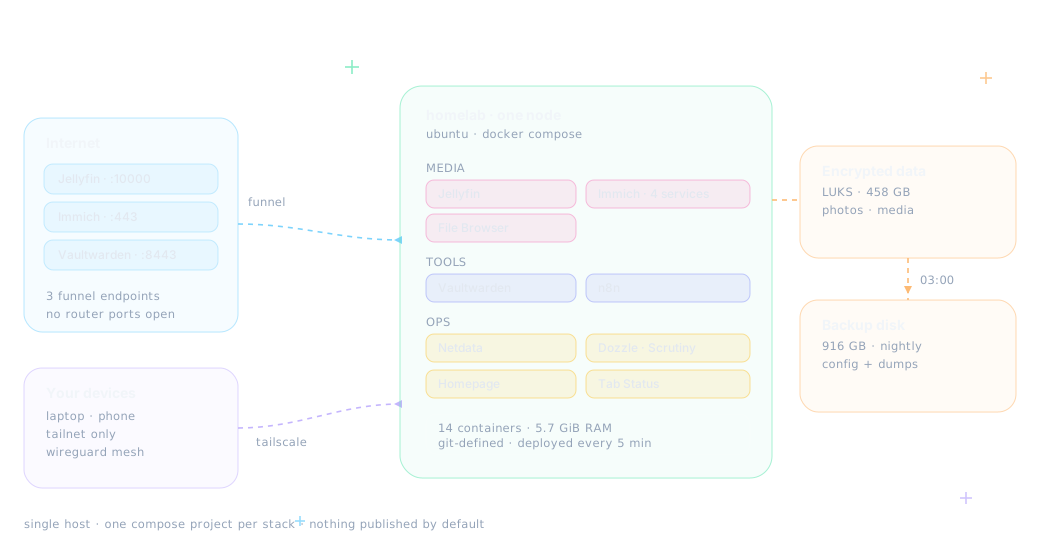
Two ways in — the public internet through three Funnel endpoints, and your own devices over WireGuard. One node in the middle, two disks behind it.

Simplified topology: internet and your devices connect over Tailscale to one homelab node running media, tools and ops containers, which write to an encrypted data disk and a nightly backup disk.

Need ports, container names and bridge networks? Open the detailed map →

See how it is wired